How Are RVs Easier to Travel Around With
- RV Lifestyle
- get inspired
Key Points at a Glance
-
RVs combine your ride, your bed, and your kitchen into one vehicle, which is the core reason RVs are easier to travel with than flying or driving a regular car with hotel stops
-
You pack once at the start of your trip instead of unpacking and repacking at every hotel along the way
-
An always-available kitchen and bathroom mean no searching for restaurants or public restrooms during long stretches of driving
-
There's no flight schedule or rental car pickup to coordinate, since your transportation and lodging are the same vehicle
-
Different RV classes, from compact camper vans to full-size Class A motorhomes, let you match your rig to your travel style and comfort needs
-
RVs make it easy to change your travel plans on a whim, whether that means staying an extra night somewhere unexpected or skipping a stop entirely
Anyone who has coordinated a flight, a rental car pickup, and a hotel check-in for a single trip knows how many separate pieces have to line up perfectly for a vacation to go smoothly. Miss a connection, and the rental car counter closes before you get there. Book a hotel too early, and you're stuck with a non-refundable room even if your plans change. Every part of the trip depends on every other part working exactly as scheduled.
RVs remove most of that coordination entirely. Instead of juggling separate reservations for transportation and lodging, you have one vehicle that handles both. This guide breaks down exactly how are RVs easier to travel around with, from the everyday conveniences like packing and cooking to the bigger picture of matching the right RV type to your travel style, so you can see for yourself why so many travelers make the switch.
How Are RVs Easier to Travel Around With?
The short answer is that an RV combines everything a typical trip requires into a single vehicle. Your transportation, your bed, your kitchen, and your bathroom all travel with you, which means far fewer moving parts to plan around and far less that can go wrong along the way.
Compare that to a typical trip that involves flying or driving a regular vehicle:
|
Trip Element |
Regular Trip |
RV Trip |
|
Transportation |
Flight, rental car, or personal vehicle |
Your RV, door to door |
|
Lodging |
Hotel booked in advance |
Wherever you park |
|
Meals |
Restaurants for every meal |
Cook whenever you want |
|
Packing |
Unpacked and repacked at each stop |
Packed once, stays in place |
|
Schedule |
Fixed around flights and check-in times |
Flexible, changeable day to day |
Every one of those regular trip elements is a separate reservation, a separate cost, and a separate point where something could go wrong. An RV collapses all of it into one vehicle you're already driving, which is the core reason RVs are easier to travel around with than nearly any other travel style.
The sections below break down exactly what that looks like in practice, starting with one of the most immediate everyday benefits: never repacking a suitcase.
Pack Once and Skip the Nightly Repacking
One of the most underrated conveniences of RV travel is something most people don't think about until they're living without it: you only pack once. Everything stays exactly where you put it for the entire trip, whether that's three days or three weeks.
Compare that to a typical hotel-based trip. Every stop means unpacking your suitcase, finding space for your things in an unfamiliar room, and then repacking everything the next morning before you leave. On a week-long trip with several stops, that can mean packing and unpacking six or seven separate times.
With an RV, your clothes stay in drawers, your toiletries stay in the bathroom, and your snacks stay in the kitchen. You simply drive to your next stop and step outside, no bags to gather or rooms to check out of.
A few reasons this matters more than it might seem:
-
Less time spent on logistics: Every minute not spent packing is a minute spent actually enjoying the trip.
-
Fewer things get left behind: Constantly repacking increases the odds of forgetting something in a hotel room.
-
More organized storage: RVs are designed with built-in cabinets, drawers, and compartments, so everything has an actual place instead of living in a suitcase.
For families especially, this alone can make a noticeable difference in how relaxed a trip feels. Kids' clothes, toys, and gear stay put instead of getting reorganized into bags every single day.
An Always-Available Kitchen and Bathroom
Anyone who has been stuck looking for a clean restroom on a long stretch of highway, or paid restaurant prices three times a day, will immediately understand this advantage. An RV comes with both a kitchen and a bathroom built in, available any time you need them.
This matters most during long driving days. Instead of timing your bathroom breaks around gas station stops or planning meals around whatever restaurant happens to be near the highway, everything you need is already with you.
A few practical ways this plays out:
-
No searching for restrooms: Your own bathroom is always just a few steps away, no matter where you are.
-
Home-cooked meals on your schedule: Stop wherever looks nice, cook a real meal, and get back on the road when you're ready.
-
Healthier and cheaper eating: Restaurant meals three times a day add up fast, both in cost and in how you feel after a few days of fast food.
-
No coordinating meal stops with a group: Traveling with kids or a larger group means fewer arguments over where to eat, since the kitchen is already stocked.
This is one of the areas where RV travel doesn't just match a hotel-based trip, it genuinely improves on it. A hotel room doesn't travel with you between stops, but your RV's kitchen and bathroom always do.
No Flights or Rental Cars to Coordinate
A typical vacation that involves flying usually means coordinating at least three separate reservations: the flight itself, a rental car once you land, and a hotel for every stop along the way. Each one depends on the others running on schedule, and a delay in one can throw off everything that follows.
RV travel skips that entire chain. There's no flight to catch, no rental car counter to wait at, and no risk of a delayed connection throwing off your whole itinerary. You're driving your own vehicle from the moment your trip starts to the moment it ends.
A quick comparison of what each trip actually requires:
|
Trip Type |
Reservations Needed |
|
Flying + rental car + hotels |
Flight, rental car, hotel for each stop |
|
Driving a regular vehicle + hotels |
Hotel for each stop |
|
RV road trip |
Just the RV itself |
This is especially useful for road trips that cover a lot of ground. Instead of flying into one city, renting a car, and then driving to a second or third destination, an RV lets you start driving from day one and keep going, no drop-off deadlines or one-way rental fees to worry about.
It also removes a layer of stress that's easy to underestimate. Missing a flight or arriving late to a car rental counter can derail an entire day of a trip. With an RV, that risk simply doesn't exist.
Change Plans and Extend Your Stay on a Whim
One of the most freeing parts of RV travel is how easy it is to change your mind. Found a national park you didn't expect to love? Stay another night. Realized a planned stop isn't worth the detour? Skip it and keep driving. None of that flexibility exists with a fixed hotel booking or a return flight already scheduled.
A typical trip locks you into a lot of decisions before you ever leave home. Hotel reservations, especially the cheaper, non-refundable kind, penalize you for changing plans. Flights come with change fees or rebooking hassles. An RV trip has none of that built-in rigidity.
A few ways this flexibility shows up in practice:
-
Extend a stay without penalty: If a campground has availability, staying an extra night is often as simple as asking.
-
Skip a stop without losing money: There's no non-refundable booking to forfeit if your plans shift.
-
Take the scenic route: Without a flight to catch, there's no reason not to pull off for a roadside attraction or an unplanned detour.
-
Adjust for weather: Bad weather at one stop just means moving on to the next one, rather than being stuck waiting out a storm in a city you didn't plan to spend extra time in.
This kind of flexibility changes the entire feel of a trip. Instead of following a rigid schedule built weeks in advance, you're free to let the trip unfold the way it actually wants to.
Finding the Right RV Type Makes Travel Even Easier
Everything covered so far applies to RV travel in general, but the specific type of RV you choose also plays a real role in how easy your trip feels. Different RV classes are built for different travel styles, and picking the right one can make a noticeable difference in how comfortable you are behind the wheel and how much space you have to live in once you've parked.
Before diving into the specific types, it helps to understand the two broad categories:
|
Category |
What It Means |
|
Motorized RVs |
The living space and the engine are one vehicle (Class A, B, and C) |
|
Towable RVs |
A separate tow vehicle pulls the RV or travel trailer behind it |
Motorized RVs, sometimes just called an RV, are generally simpler for road trips since there's only one vehicle to drive and park. Towable RVs, including travel trailers and truck campers, offer the advantage of disconnecting your tow vehicle once you've parked, so you can explore nearby areas without breaking down the whole campsite.
Neither option is universally better. It really comes down to your travel style, how much space you need, and how comfortable you are driving or towing a larger vehicle. The next several sections walk through the most common RV types so you can see which one fits your kind of trip best.
Class A Motorhomes for Full-Size, Long-Haul Comfort
Class A motorhomes are the largest and most spacious option on the road, built on a heavy-duty truck chassis or bus chassis and designed for long trips where comfort matters as much as convenience. If you're picturing the classic image of a full-size RV, this is likely what comes to mind.
What makes a Class A a good fit for certain travelers:
-
Spacious interiors: Class A motorhomes typically offer the most interior space and living space of any RV type, often including multiple slide outs that expand the room even further once parked.
-
Higher sleeping capacity: Many models comfortably sleep six or more people, making them a strong choice for larger families or groups.
-
Full interior amenities: Residential-style kitchens, larger bathrooms, and dedicated sleeping areas are standard on most Class A models.
-
Best for long trips: The extra space and comfort make a real difference on trips lasting a week or longer.
|
Feature |
Class A Motorhome |
|
Length |
Typically 30-45 feet |
|
Sleeping capacity |
Often 6+ people |
|
Best for |
Families, groups, long trips |
|
Driving experience |
Requires more skill due to size |
The trade-off is size. Class A motorhomes take more skill to maneuver, particularly in tight spaces, narrow roads, or crowded parking lots. They're not the easiest option for quick weekend trips or destinations with tricky access, but for travelers prioritizing space and comfort over easy maneuvering, they're hard to beat.
Class B Motorhomes: Compact and Easy to Drive
Class B motorhomes, often just called camper vans, are the most compact motorized RV option available. Built on a standard van chassis, they offer a driving experience that feels much closer to a regular vehicle than a traditional RV.
What makes Class B motorhomes stand out:
-
Easy maneuvering: Their smaller footprint means less difficulty in parking lots, narrow city streets, or winding mountain roads.
-
Compact but functional: Despite the smaller size, most Class B models still include a small kitchen, a bathroom, and a sleeping area.
-
Great for solo travelers or couples: The smaller interior space is well suited to one or two people rather than a larger group.
-
Fits in regular parking spaces: Unlike larger RVs, many Class B motorhomes fit into standard parking spots, which simplifies stops at grocery stores or attractions.
|
Feature |
Class B Motorhome |
|
Length |
Typically 17-23 feet |
|
Sleeping capacity |
Usually 2-4 people |
|
Best for |
Solo travelers, couples, shorter trips |
|
Driving experience |
Closest to driving a regular vehicle |
The trade-off for that easier maneuvering is less interior space overall. Storage is more limited, and sleeping space is tighter than in a larger RV. But for travelers who value ease of driving and parking over maximum room, a Class B is one of the easiest RV types to get comfortable with quickly.
Camper Vans for Everyday Simplicity
While "camper van" and "Class B motorhome" often describe the same type of vehicle, it's worth calling out on its own because of how naturally it fits into everyday use, not just dedicated road trips. A camper van drives, parks, and handles so much like a regular vehicle that many owners use them for daily errands between trips.
A few reasons camper vans stand out for everyday simplicity:
-
Drives like a regular vehicle: No special towing skills or oversized-vehicle awareness needed, it handles like the van it's built on.
-
Parks almost anywhere: Regular parking spaces, city streets, and standard driveways are usually no problem.
-
Quick to set up and pack down: There's no towing to disconnect or leveling to manage, just park and you're settled.
-
Doubles as a daily driver: Some owners use their camper van for regular trips around town, not just for camping.
|
Use Case |
Why a Camper Van Fits |
|
Weekend trips |
Quick to load up and hit the road |
|
City-adjacent destinations |
Fits into regular parking and narrow streets |
|
Solo or couple travel |
Right-sized without excess space to manage |
|
Combining errands and travel |
Comfortable enough to drive regularly, not just for trips |
For travelers whose priority is simplicity above all else, whether that's a long weekend getaway or a longer trip where ease of driving matters more than space, a camper van offers some of the lowest-friction RV travel available.
Class C RVs: A Practical Middle Ground
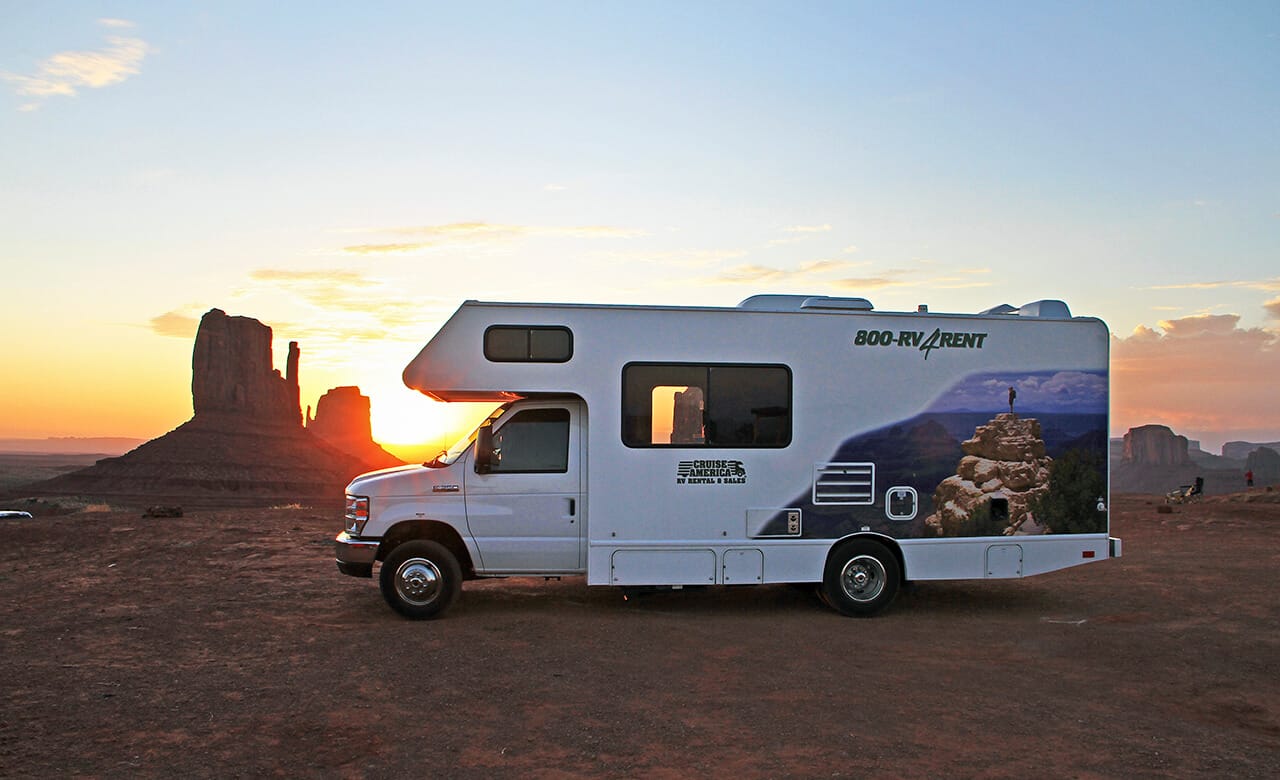
Class C RVs sit between the compact simplicity of a Class B and the full-size comfort of a Class A, and that middle-ground position is exactly why they're one of the most popular rental choices. Built on a truck chassis with a distinctive over-cab sleeping area, a Class C RV offers noticeably more space than a camper van without the size and driving difficulty of a Class A.
What makes a Class C RV a practical choice for a lot of travelers:
-
More space than a Class B: A full kitchen, a separate bathroom, and often a dedicated bedroom in addition to the over-cab sleeping area
-
Easier to drive than a Class A: Built on a more familiar truck chassis, Class C RVs are generally more approachable for first-time RV drivers
-
Good sleeping capacity for families.:Many Class C models comfortably sleep 6 to 8 people between the main bedroom, the over-cab area, and convertible seating
-
Balanced size for road trips: Large enough to feel comfortable on longer trips, without being unwieldy on regular roads
|
Feature |
Class C RV |
|
Length |
Typically 20-33 feet |
|
Sleeping capacity |
Often 6-8 people |
|
Best for |
Families, first-time RV drivers, road trips of any length |
|
Driving experience |
More approachable than a Class A |
For travelers who want real living space and a proper kitchen without committing to the size and learning curve of a full Class A, a Class C RV is often the sweet spot. It's a big part of why this class is such a common rental option for first-time RV travelers.
For those who need even more space, Super C motorhomes take the same basic layout and build it on a heavier-duty truck chassis, offering more power and towing capacity for travelers who want extra capability alongside the practical Class C layout.
Compact RV Options for Easier City-to-Campground Driving
Not every trip calls for a large motorhome, and for travelers who move between cities and campgrounds frequently, a compact RV often makes the whole trip easier. Smaller size means less to think about at every stop, from parking to fuel stops to navigating unfamiliar roads.
A few reasons a compact RV shines for this kind of travel:
-
Smaller footprint everywhere you go: Compact RVs fit into more parking lots, campground sites, and city streets than larger rigs.
-
Better fuel economy: Smaller, lighter vehicles generally get better gas mileage than larger motorhomes, which matters on longer routes.
-
Less intimidating for new drivers: A compact RV is a much smaller adjustment from driving a regular vehicle than jumping straight into a large Class A.
-
Easier access to tighter destinations: Some scenic routes and smaller campgrounds simply aren't built for larger RVs.
|
Trip Type |
Why a Compact RV Fits |
|
City-to-campground trips |
Easier parking and navigation in urban areas |
|
First-time RV travelers |
Smaller learning curve behind the wheel |
|
Fuel-conscious travel |
Better fuel economy than larger models |
|
Trips with mixed stops |
Flexible enough for both cities and remote destinations |
The trade-off, as with any smaller RV, is reduced space compared to larger models. But for travelers whose itinerary bounces between city stops and campgrounds, that smaller footprint often outweighs the extra room a bigger RV would offer.
Pop-Up Campers: Lightweight and Easy to Tow
For travelers who want the RV experience without driving a motorized rig at all, pop-up campers offer one of the lightest and easiest towing options available. These fold-down towable RVs expand once parked, offering real sleeping space in a package that's easy to pull with a wide range of vehicles.
What makes pop-up campers stand out:
-
Lightweight towing: Most pop-up campers are light enough to be towed by a regular SUV or a smaller pickup truck, no heavy-duty tow vehicle required.
-
Compact for storage and driving: Folded down, a pop-up camper is small enough to store easily and doesn't add much height or length behind your vehicle.
-
Closer to tent camping, with more comfort: Pop-up campers offer a step up from tent camping, with real beds and basic protection from the weather, while still feeling connected to the outdoors.
-
Lower towing learning curve: Their light weight and compact size make them one of the more approachable towable RVs for first-time towing.
|
Feature |
Pop-Up Camper |
|
Weight |
Generally among the lightest towable RVs |
|
Tow vehicle needed |
Often a regular SUV or smaller pickup truck |
|
Best for |
Travelers who want simplicity and easy towing |
|
Comfort level |
A step up from tent camping |
Compared to a small travel trailer or a lightweight travel trailer with a hard shell, pop-up campers trade some weather protection and rigidity for an even lighter, more towable package. For travelers whose main priority is easy towing without investing in a dedicated tow vehicle, they're one of the simplest towable options on this list.
Gas Mileage: What to Expect Behind the Wheel
Whichever RV type you choose, it helps to have realistic expectations about gas mileage before you hit the road. Larger RVs use noticeably more fuel than regular vehicles, and understanding that upfront makes it easier to plan your route and your budget.
A general sense of what to expect across RV types:
|
RV Type |
Typical Gas Mileage |
|
Class B motorhome / camper van |
18-25 MPG |
|
Class C RV |
10-15 MPG |
|
Class A motorhome |
6-10 MPG |
|
Towable RV (with tow vehicle) |
Depends heavily on tow vehicle and RV weight |
A few factors that affect fuel consumption regardless of RV type:
-
Vehicle weight: Heavier RVs, especially larger motorhomes with multiple slide outs, use more fuel than smaller, lighter models
-
Driving speed: Slower highway speeds generally improve fuel economy in larger vehicles
-
Terrain: Mountainous routes and high winds increase fuel consumption more noticeably in an RV than in a regular vehicle
-
Gas prices along your route: Prices can vary significantly by region, so route planning can help manage overall fuel costs
While an RV won't match the fuel economy of a regular passenger vehicle, the savings on hotels, rental cars, and restaurant meals typically offset the difference in gas mileage, especially on longer trips where those other costs would otherwise add up night after night.
Off-Grid Freedom on Your Own Schedule
One of the biggest advantages of RV travel is the ability to go off grid entirely, camping in remote locations without sacrificing the basic comforts of a bed, a bathroom, and a kitchen. This kind of freedom simply isn't available to travelers relying on hotels or flights.
A few ways off-grid travel expands what an RV trip can look like:
-
Access to remote locations: Many of the most scenic spots in the country aren't near a hotel at all, but an RV can get you there and let you stay overnight
-
No dependence on hookups: With the right setup, RVs can run without full hookups for several days at a time, opening up dispersed camping options
-
High clearance options for rougher roads: Certain RV types, particularly truck campers and some Class C models, offer enough clearance to handle off-road or unpaved routes to reach these locations
-
A quieter, more private experience. Off-grid camping generally means fewer crowds and more distance from other travelers
|
Travel Style |
What's Possible |
|
Hotel-based travel |
Limited to wherever hotels exist |
|
RV travel with hookups |
Developed campgrounds, more amenities |
|
Off-grid RV travel |
Remote locations, public lands, dispersed camping |
This kind of flexibility is part of what makes RV travel feel fundamentally different from other trip styles. Instead of being limited to wherever the nearest hotel happens to be, an RV opens up destinations that would otherwise be completely out of reach.
Getting Closer to the Great Outdoors
At the end of the day, the reason most people choose RV travel isn't just about convenience, it's about getting closer to the great outdoors without sacrificing comfort. An RV lets you wake up next to a lake, a mountain trail, or a quiet forest instead of a hotel parking lot, all while still having a real bed and a working kitchen.
A few ways RV travel brings you closer to outdoor adventures:
-
Camp where the views are: Instead of driving to a trailhead from a hotel miles away, many campgrounds put you steps from the outdoor adventures you came for
-
Extend your time outside: Since you're not racing back to a hotel before check-in cutoffs, there's more room to linger for sunset or an early morning hike
-
Bring your gear along: Exterior storage on most RVs makes it easy to carry bikes, kayaks, or hiking gear without cramming a car trunk
-
Experience different landscapes on one trip: Whether it's a national park, a stretch of coastline, or a quiet stretch of countryside, an RV makes it easy to move between very different outdoor settings without the travel logistics slowing you down
For families especially, this combination of comfort and outdoor access creates a kind of family travel that's hard to replicate with a hotel-based trip. Kids can spend the day outside and come back to a familiar space each night, no matter how remote the destination.
Book Your Cruise America RV
Ready to experience travel without the coordination headaches? Book your Cruise America RV rental today and see for yourself how much easier the road can be when your ride, your bed, and your kitchen all travel together.